
Bistable Materials: 1) Spin-Crossover Materials
 分类:research
 作者:
作者:
 发布时间:2026-09-27
Spin crossover (SCO) refers to the reversible transition of the electronic spin state of a transition metal ion in certain coordination complexes between the high-spin (HS) and low-spin (LS) states, induced by external stimuli such as temperature, pressure, or light. SCO arises from the delicate competition between the ligand field splitting energy and the electron pairing energy. When these two energies are comparable, an external perturbation (e.g., thermal fluctuations, kBT) can induce electronic reconfiguration, altering the number of unpaired electrons.
This phenomenon occurs mainly in octahedral complexes of first-row transition metals, typically with electron configurations from 3d4 to 3d7. The most extensively studied case is Fe(II) (3d6) complexes (Figure 1), which exhibit the most pronounced change: from a low-spin diamagnetic state (S = 0) to a high-spin paramagnetic state (S = 2).
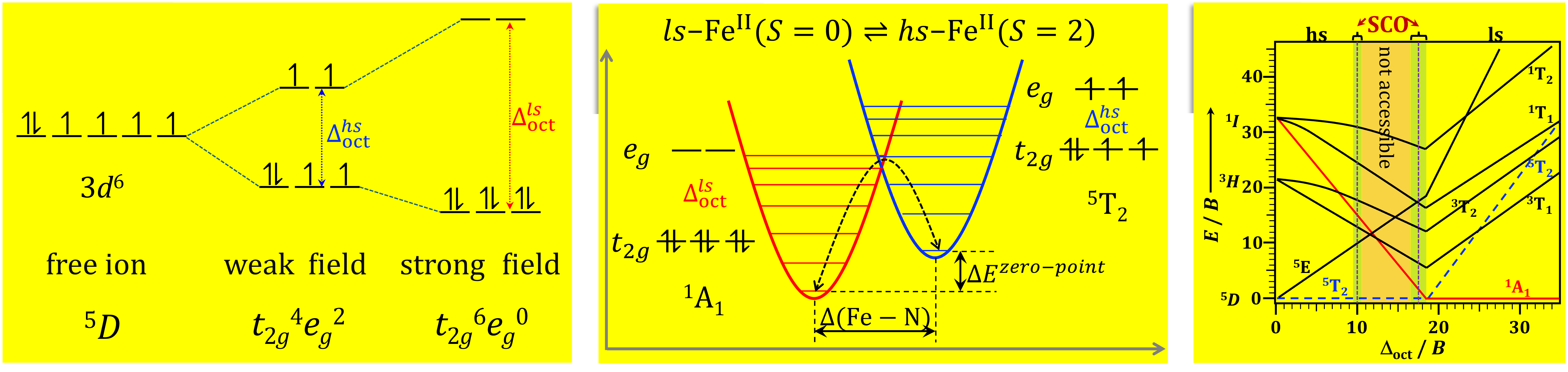
Figure 1. The phenomenon of spin crossover (left), energy difference (middle) of HS and LS states, and ligand field conditions for SCO.
The spin-state transition is usually accompanied by significant changes in macroscopic properties:
· Structure: Metal–ligand bond lengths typically change by about 10% (longer in the HS state).
· Magnetism: An abrupt change in magnetic moment, one of the most direct means of monitoring SCO.
· Optics: The complex often undergoes a pronounced color change (e.g., from purple/dark red to colorless/yellow).
These changes make SCO materials promising candidates for a wide range of cutting-edge applications, which can be summarized as follows:
1. Molecular switches and memory devices
The two accessible spin states can serve as binary "0" and "1" states, making SCO complexes attractive candidates for molecular-level data storage, logic gates, and spintronic devices. Light-induced excited spin state trapping (LIESST) allows optical writing and thermal or optical erasing of information, enabling photo-switchable memory elements and molecular transistors.
2. Sensors and actuators
Because the HS–LS transition is sensitive to temperature, pressure, and chemical environment, SCO materials are promising for high-sensitivity sensors. They can detect volatile organic compounds, humidity, or mechanical stress through measurable changes in color or magnetism. SCO-based actuators can convert small external stimuli into mechanical motion, useful in microelectromechanical systems (MEMS) and artificial muscles.
3. Display and smart materials
The pronounced thermochromic and piezochromic behavior of many SCO complexes—often changing from deep red/purple (LS) to pale yellow/white (HS)—makes them suitable for temperature-indicating labels, anti-counterfeiting inks, and smart windows. Thin films and nanoparticles of SCO compounds can be integrated into flexible displays and wearable devices.
4. Molecular electronics and spintronics
SCO complexes can be grafted onto surfaces or embedded in junctions, where the spin state controls charge transport and magnetoresistance. This offers a route to spin valves, spin filters, and quantum information processing elements, since the HS and LS states can encode quantum bits with long coherence times.
5. Catalysis and chemical reactivity
The spin state of a metal center strongly influences its reactivity. SCO catalysts can therefore be switched "on" and "off" by external stimuli, providing a basis for stimuli-responsive catalysis, controlled drug release, and smart reaction systems.
6. Biomedical applications
SCO nanoparticles are being explored as contrast agents for magnetic resonance imaging (MRI), since the large change in magnetic moment alters relaxivity. They also show potential in targeted drug delivery, where a stimulus-induced spin transition triggers payload release, and in photothermal therapy.
Our research focuses on bistable functional materials, with spin crossover (SCO) as a central theme. We systematically address the design, modulation, and functionalization of SCO compounds, particularly through supramolecular engineering and multifunctional integration.
A major thrust of our research is the construction of SCO-active metal–organic cages (SCO MOCs). In 2024, we reported the first air-stable Fe(III) SCO-MOC with pH-responsive magnetic behavior (Figure 2). This octanuclear cage uses intramolecular double-proton mutual repulsion to achieve reversible high-spin/low-spin switching controlled by acid/base stimuli. The deprotonation of pyrimidine NH sites removes steric hindrance and triggers a LS-to-HS transition, while re-protonation restores the LS state. This pH-driven magnetic switching offers potential for magnetic resonance imaging optimization and targeted drug delivery systems.
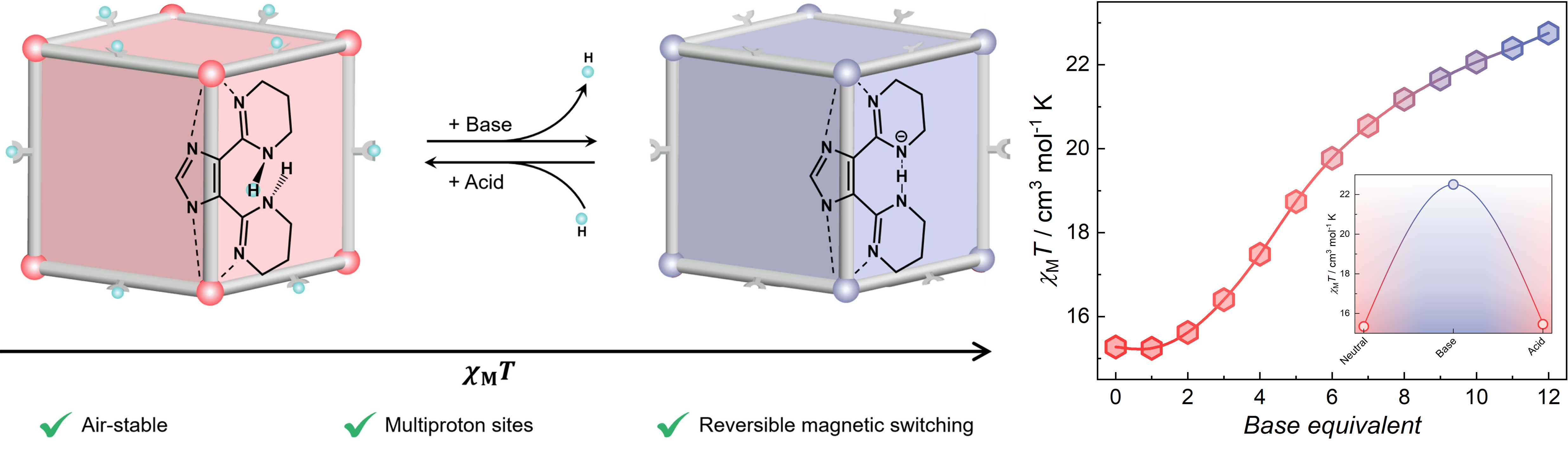
Figure 2. A ferrous octahedral MOC showing reversible acid/base-tunable SCO behaviors.
Another important system is the Hofmann-type SCO compounds. We recently reported a porous SCO Hofmann-type framework with atypical pore rearrangement: water adsorption induces a reversible narrow-pore to large-channel transformation, accompanied by a change from two-step SCO without a plateau to two-step SCO with a large plateau (Figure 3).
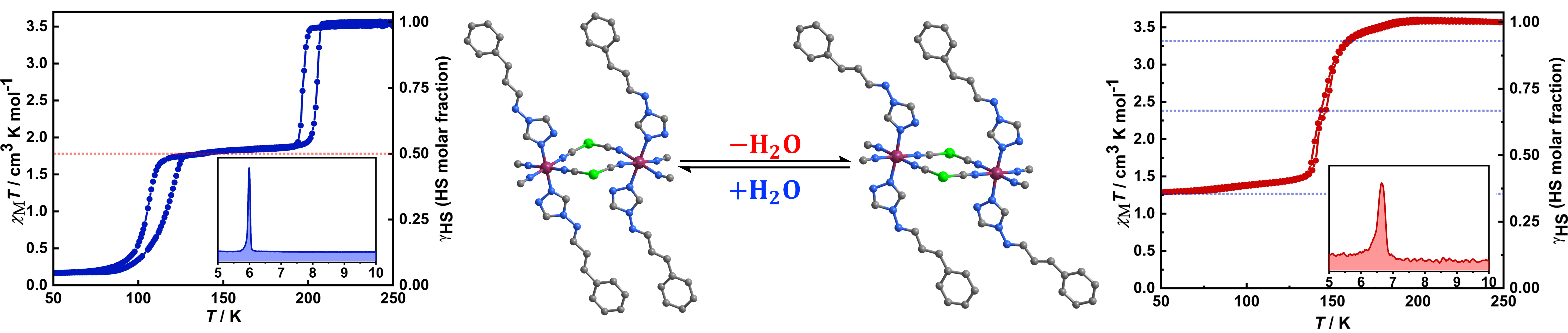
Figure 3. Guest water desorption/adsorption-induced ligand rotation couples with SCO in a Hofmann-type framework.